

Borderlands (2024)
Live-action NPCs in a carbon-copy world

The Borderlands games are not narratively sophisticated. That has never been the point. What they are is tonally specific -- a very particular frequency of anarchic irreverence, loot-driven chaos, and self-aware absurdism that holds together because all of its parts are vibrating at the same rate. Play any of them for twenty minutes and you understand the world you’re inside. The humor knows what it is. The violence knows what it is. Even the empty stretches of shooting feel calibrated to the same internal logic.
The 2024 film has none of that. Not because it fails to reproduce the surface elements -- the wastelands, the loot chests, the irreverent narration are all present -- but because those elements are no longer tuned to anything. They’re there the way furniture is present in a staged house: correctly positioned, not actually lived in.
Jack Black voices Claptrap. In the games, Claptrap is sensory saturation -- a noise machine with feelings, impossible to ignore. Watching the film, I kept thinking: who is that? The voice didn’t register as Black, and it didn’t register as Claptrap either. It was just sound occupying the space where a character should be. The original game voice is so specific, so embedded in the property’s identity, that recasting it without finding a new frequency for the role produces something that is neither the thing you remember nor a convincing replacement. It’s a voice in a costume.
The film’s relationship to its source material is citation rather than translation. Easter eggs aren’t woven into the fabric of the world -- they’re pointed at. “We included the thing. There it is, in live action.” Compare this to The Super Mario Bros. Movie (2023), which hides deep-cut references that non-fans don’t need and fans find without prompting. Those details reward attention. They don’t demand it. The distinction matters: one approach treats the audience as collaborators, the other treats them as authenticators.
Visually, the film never convincingly rebuilds the game’s world for live action -- it ports it. The environments look like game assets. The actors look green-screened into them. It’s a carbon copy where the seams are always visible. What’s strange is that A Minecraft Movie (2025) appears to solve the same problem from the opposite direction -- it keeps the block aesthetic but makes it feel epic and filmic in scope, so the artificiality becomes intentional rather than accidental. Borderlands just looks like it didn’t finish the job.
The strangest inversion is the actors themselves. In a film where the world looks like a game asset, the human beings are somehow the least alive thing on screen. The characters -- some played by genuinely accomplished performers -- register as live-action NPCs rather than sentient people. Their motivations technically exist, their quirks are technically present, but none of it coheres into anyone you believe in. If you’ve played the games, you can supply the missing depth from memory. If you haven’t, there’s simply nothing there. Either way, the film isn’t doing the work. The most uncanny valley element in this entire production isn’t the CGI. It’s the people.
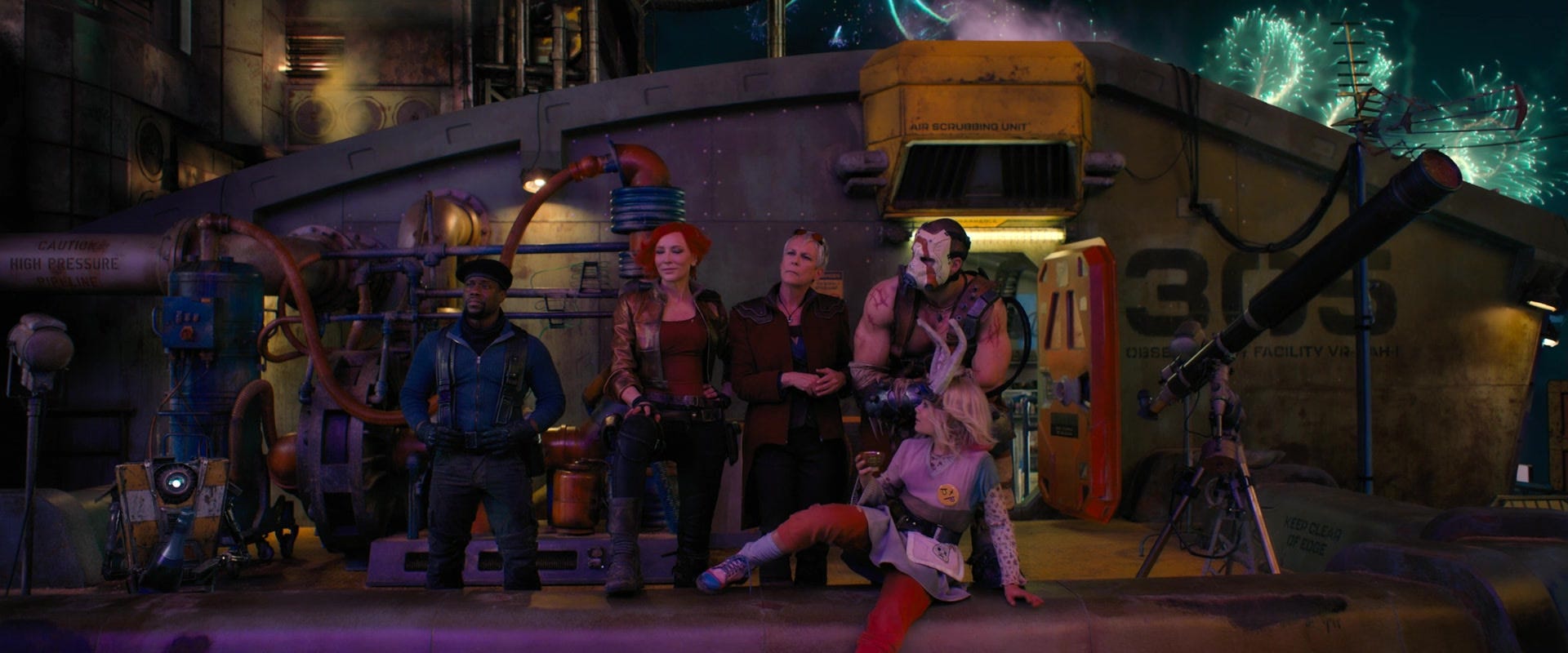
Ariana Greenblatt plays Tiny Tina, the central role the story orbits around. She’s not great here -- no one is -- but there’s something faintly registering beneath the material. Enough that I’d be willing to see her again in something that asks more of her.
The veteran actors attached to this are known for considerably better work. They were presumably compensated accordingly. The film doesn’t offend -- it simply produces no signal. Which, in its own way, might be the most damning thing you can say about it.
We are finally -- finally -- arriving at a moment where video game adaptations can be genuinely good. The evidence is accumulating. Which makes this particular failure sting more than it otherwise would. The planet of Pandora and the universe surrounding it are legitimately rich. There is something real to work with there. That this film couldn’t find it, or didn’t try hard enough to look, is a disappointment that belongs not just to the critics but to the legion of fans who already knew what this world was capable of.
First-time watch -- 2024. ★✭☆☆☆ (1.5/5)